5 Signs Your NRH Home Needs Foundation Attention
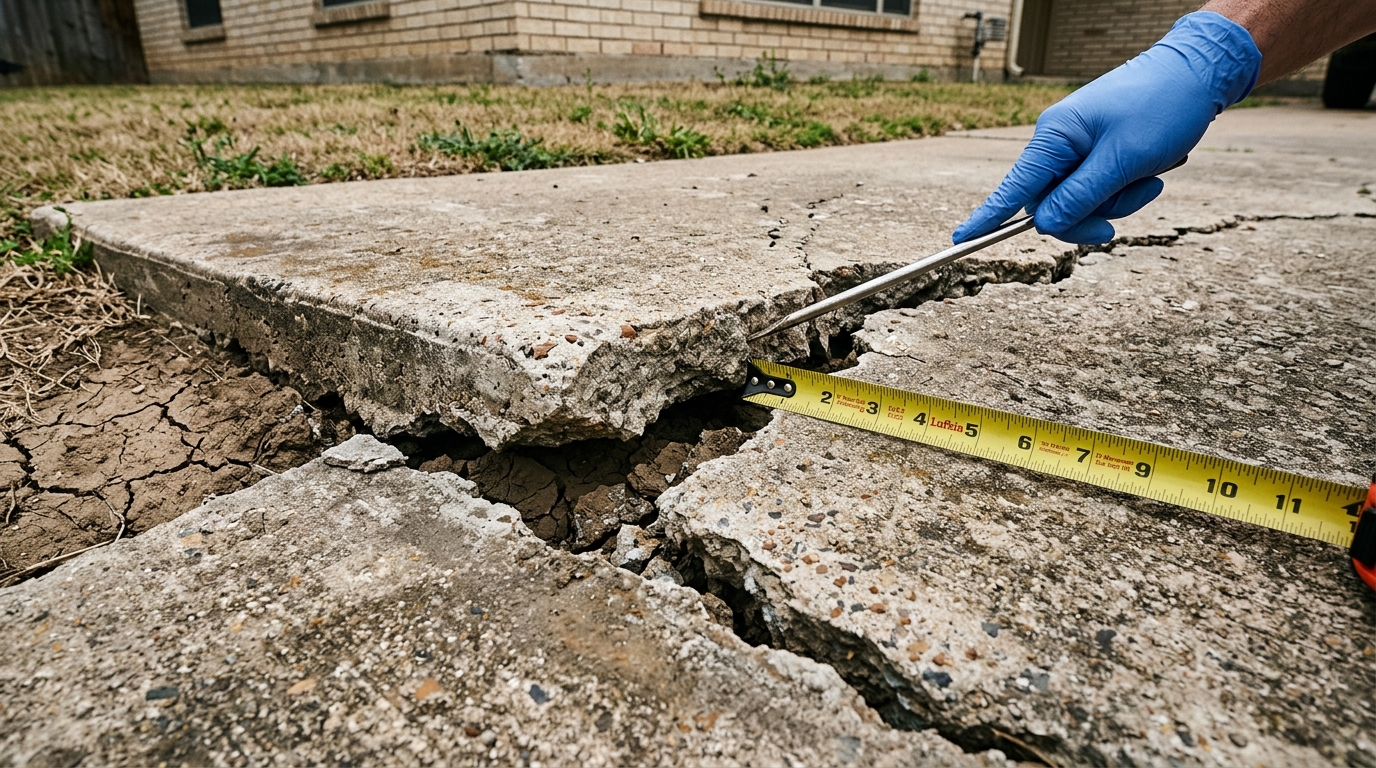
Foundation movement is one of the most common home concerns in North Richland Hills — and one of the most misunderstood. Thanks to Tarrant County’s expansive Blackland Prairie clay soils, some degree of seasonal foundation movement is normal for virtually every NRH home. The question isn’t whether your foundation moves; it’s whether the movement is within an acceptable range or whether it’s progressing to the point of causing genuine structural or water intrusion problems.
In this post, we will cover the 5 most telling warning signs of problematic foundation movement in NRH homes, what those symptoms actually mean, which can be monitored and which require urgent attention, and how clay soil conditions in Tarrant County create the conditions that produce them.
Foundation Concerns in North Richland Hills?
We assess concrete slab conditions and advise on the right next steps. Call (888) 376-0955 for a free evaluation.
Sign 1: Doors and Windows That Stick or Won’t Close
This is the most commonly reported early sign of foundation movement in NRH homes. When the clay beneath one portion of the foundation swells or settles more than another portion — what engineers call differential movement — the rigid frame of the house distorts slightly. Door frames that are no longer quite square bind against their doors. Window frames that have racked slightly won’t slide or close cleanly.
What to watch for: A door or window that worked fine a year ago but now consistently sticks, particularly if the problem varies with the season (worse in summer drought, better after rain) is a classic sign of clay-driven differential movement.
When it’s concerning: One or two slightly sticky doors that correlate with extreme drought conditions is relatively normal in NRH. Multiple doors throughout the house that stick regardless of season, or doors that have gotten progressively worse over 1–2 years, warrant a foundation assessment.
Sign 2: Diagonal Cracks at Window and Door Corners in Drywall
When a foundation moves differentially, the drywall installed over the framing develops stress at the points of greatest movement. The characteristic pattern is diagonal cracks radiating from the corners of window and door openings — the opening creates a stress concentration in the drywall sheet, and that’s where the crack propagates.
What to watch for: Hairline cracks at door and window corners are common in NRH homes, especially after the first year or two of settlement. Cracks that are wider than 1/8 inch, that are growing, or that appear in multiple locations throughout the house simultaneously are more significant.
When it’s concerning: Cracks that appear suddenly after a long drought or after unusually wet weather, cracks wider than 3/8 inch, or cracks accompanied by other symptoms on this list warrant professional evaluation.
Documenting Foundation Symptoms in Your NRH Home?
Photograph and date any cracks you observe — this documentation is valuable for any foundation assessment. Call (888) 376-0955.
Sign 3: Cracks in Exterior Brick or Mortar Joints
NRH’s brick exterior homes are particularly diagnostic because brick doesn’t flex — it cracks. Stair-step cracks in mortar joints, horizontal cracks in brick courses, or cracked individual bricks all indicate that the wall has moved more than the rigid masonry can accommodate without fracturing.
What to watch for: Stair-step cracks following mortar joints are the classic differential settlement pattern — the wall has dropped on one side and the crack propagates diagonally through the weakest points (the mortar joints). Horizontal cracks, especially near the foundation level, can indicate the wall is being pushed or pulled apart by soil movement.
When it’s concerning: Any brick cracking that is visible from street level, cracks wider than 1/4 inch, or cracks that have grown measurably since you last observed them are worth having evaluated by a foundation professional.
Sign 4: Uneven or Sloping Floors
When the slab beneath your home settles or heaves unevenly, the floors installed above the slab reflect that movement. Tile floors may develop loose or cracked tiles; hardwood floors may cup or develop visible slopes; you may notice a marble or ball rolling on its own across what appears to be a level room.
What to watch for: A marble test on hard flooring in multiple rooms can help you identify whether and where floors are sloping. More than 1/4 inch of slope across 20 linear feet is often considered the threshold for concern — though tolerance varies by floor type and finishes.
When it’s concerning: Progressive slope that has increased over months, slope concentrated in one area of the house suggesting localized settlement, or uneven floors accompanied by other symptoms on this list all warrant evaluation.
Sign 5: Gaps Between Floors and Baseboards, or Walls and Ceilings
As a foundation settles or lifts unevenly, the framing above it moves but the finishes — baseboards, crown molding, trim — were installed to a different position. Gaps appear between the baseboard and the floor, or between the crown molding and the ceiling, as the wall framing shifts relative to where the finish material was originally installed.
What to watch for: Consistent, uniform gaps around an entire room’s perimeter may simply reflect normal settling after initial construction. New gaps that appear in one area only, or gaps that are growing over time, are more significant.
When it’s concerning: Gaps wider than 1/4 inch, gaps that are growing, or gaps localized to one area of the house (suggesting localized movement rather than uniform settling) warrant evaluation.
Why These Signs Occur in North Richland Hills
All five of these warning signs share a common cause: differential movement of the clay soils beneath the foundation. Tarrant County’s Blackland Prairie clay swells when wet and shrinks when dry, with potential vertical movement of up to 7 inches. A foundation designed for these conditions should accommodate seasonal movement without significant differential distortion.
The most common trigger for problematic movement in NRH is moisture imbalance — one side of the foundation dries out while the other remains damp. This happens when:
- Drought conditions cause the exposed exterior of the foundation’s clay to dry and contract while the clay beneath the interior stays moister
- Plumbing leaks under the slab saturate the clay beneath one area
- Poor drainage allows water to pool against one side of the foundation
- Large trees with extensive root systems extract moisture unevenly from the clay
Maintaining consistent moisture around your foundation perimeter through drought — with drip irrigation along the perimeter — is the most effective maintenance step NRH homeowners can take.
For more on why NRH’s soils create these conditions, read why NRH clay soil demands reinforced concrete. For information on new concrete work that may be needed as part of a remediation, see our concrete foundations service page. For concrete slabs around your home’s perimeter, read about concrete patios and concrete driveways in North Richland Hills.
Foundation Concerns in NRH? Start With an Honest Assessment
North Richland Hills Concrete Pros evaluates slab conditions and advises on the right next steps. Call (888) 376-0955.
Related: