
Concrete vs. Asphalt Driveways for North Richland Hills Homes
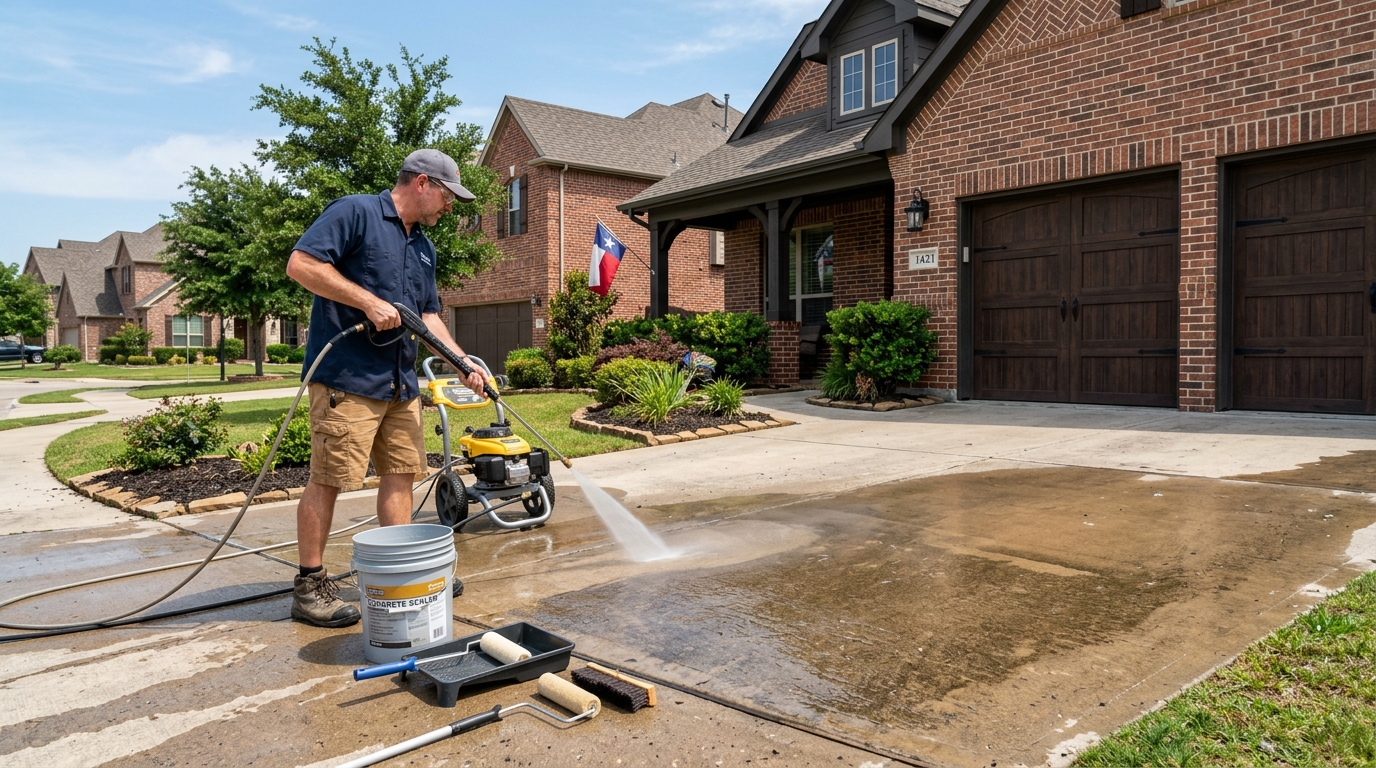
Concrete and asphalt are the two dominant residential driveway materials in North Richland Hills, and homeowners replacing an older driveway often ask which is the better long-term investment. The answer depends significantly on factors specific to NRH: the city’s permit requirements, North Texas’s extreme summer heat, and Tarrant County’s expansive clay soils. In many markets, the choice is primarily financial. In NRH, the technical performance difference between the two materials in local conditions is dramatic enough to be the deciding factor for most homeowners.
In this post, we will cover how concrete and asphalt compare on upfront cost, long-term total cost of ownership, performance in North Texas heat, performance on clay soils, maintenance requirements, and the NRH permit implications for each material.
Concrete Driveway Specialists in North Richland Hills
We'll give you an honest comparison for your specific situation. Call (888) 376-0955 for a free estimate.
Upfront Cost Comparison
Asphalt driveways in the DFW market typically run $3–$7 per square foot installed. A 400-square-foot two-car driveway costs $1,200–$2,800 for a standard asphalt installation.
Concrete driveways in North Richland Hills run $4–$8 per square foot for standard poured concrete — the city requires 5-inch thickness, 3,000 psi strength, and #3 rebar reinforcement for driveway approaches. A 400-square-foot driveway costs $1,600–$3,200, plus the permit fee and any demolition of existing material.
Upfront verdict: Asphalt is typically $1–$2 per square foot cheaper to install initially. On a 400-square-foot driveway, that’s roughly $400–$800 less at the outset.
Performance in North Texas Heat
This is where the comparison shifts decisively toward concrete for NRH homeowners. North Texas summers regularly produce temperatures exceeding 100°F, and asphalt softens significantly in that heat.
Asphalt has a softening point of roughly 115–120°F — and asphalt surfaces in direct sun regularly exceed that temperature by 20–30°F during NRH summers. Softened asphalt develops ruts under vehicle tires and can mark from high heels or furniture legs. The material also tracks into homes on foot traffic during peak summer.
Concrete does not soften in heat. Its performance characteristics are temperature-independent at the temperatures NRH experiences. Concrete may get hot to the touch in full sun (a consideration for bare-footed walking), but its structural properties don’t change.
Heat verdict: Concrete significantly outperforms asphalt in North Texas summer conditions. Asphalt’s softening problem is not a minor inconvenience in a climate that sees 60+ days above 100°F — it’s a recurring maintenance and aesthetic problem for the life of the driveway.
Performance on Tarrant County Clay Soils
Asphalt is a flexible pavement — it’s designed to flex with soil movement. This sounds advantageous for expansive clay, but in practice, asphalt’s flexibility means it deforms rather than distributing load. As clay moves beneath an asphalt driveway, the surface develops undulations and ruts that worsen with each seasonal cycle. Asphalt patching on clay soils is a recurring maintenance task.
Concrete is a rigid pavement. Properly reinforced with #3 rebar (as NRH code requires), a concrete slab distributes clay soil movement across the entire slab rather than deforming at the point of pressure. Control joints direct any cracking to predetermined locations. The NRH code requirement for rebar reinforcement reflects the city’s engineering judgment about the minimum specification needed to produce a durable driveway on Tarrant County’s clay.
Clay soil verdict: Properly installed concrete outperforms asphalt on NRH’s clay soils. The key phrase is “properly installed” — an unreinforced concrete driveway on NRH clay will also fail.
Concrete Built for NRH's Clay Soils and Summer Heat
Call (888) 376-0955 for a free estimate. We meet NRH's specifications on every project.
Total Cost of Ownership Over 30 Years
This is where the comparison most clearly favors concrete.
Asphalt requires:
- Crack sealing every 2–3 years: $50–$200 per event
- Resurfacing or overlay every 5–7 years: $1,500–$3,000 for a two-car driveway
- Full replacement at 15–20 years: $1,200–$2,800 plus demolition
Over 30 years, an asphalt driveway will likely be replaced 1–2 times and resurfaced 3–4 times. Total 30-year cost for a 400-square-foot driveway including maintenance: $8,000–$15,000+.
Concrete requires:
- Sealing every 3–5 years: $100–$300 per event
- Crack repairs as needed: $50–$500 depending on severity
- Full replacement at 30–50 years (if properly installed and maintained)
Over 30 years, a well-maintained concrete driveway typically requires only sealing and minor crack repairs. Total 30-year cost for a 400-square-foot driveway including maintenance: $3,500–$7,000.
Total cost verdict: Concrete’s higher upfront cost is more than recovered through lower maintenance costs and significantly longer service life in North Texas conditions.
NRH Permit Considerations
Both concrete and asphalt driveways require a permit in North Richland Hills for installation, replacement, or widening. However, NRH’s published specifications (5-inch thick, 3,000 psi, #3 rebar) are written for concrete. Asphalt driveways have their own specifications but are generally held to a performance-equivalent standard. We specialize in concrete and focus our permit knowledge on concrete’s requirements; if you’re considering asphalt, confirm the permitting process with an asphalt contractor familiar with NRH’s requirements.
Making the Decision for Your NRH Driveway
For most North Richland Hills homeowners, concrete is the better long-term investment. The upfront premium over asphalt pays for itself in reduced maintenance within the first 10 years, and concrete’s performance in North Texas heat and on clay soils creates fewer problems for the life of the driveway.
Asphalt makes sense if: your budget is tight and the lower upfront cost is the deciding factor, you’re planning to sell the property within a few years, or you specifically prefer asphalt’s appearance.
Concrete makes sense if: you plan to stay in the home long-term, value reduced maintenance, want a driveway that performs consistently in NRH’s extreme summers, and want the design flexibility to upgrade to a stamped or decorative finish.
For concrete pricing details, read how much a concrete driveway costs in NRH. For permit guidance, see our NRH permit guide.
Concrete Driveway Free Estimate — North Richland Hills
North Richland Hills Concrete Pros. Call (888) 376-0955 for honest, itemized pricing.
Related: