Retaining Wall Solutions for North Richland Hills Sloped Yards
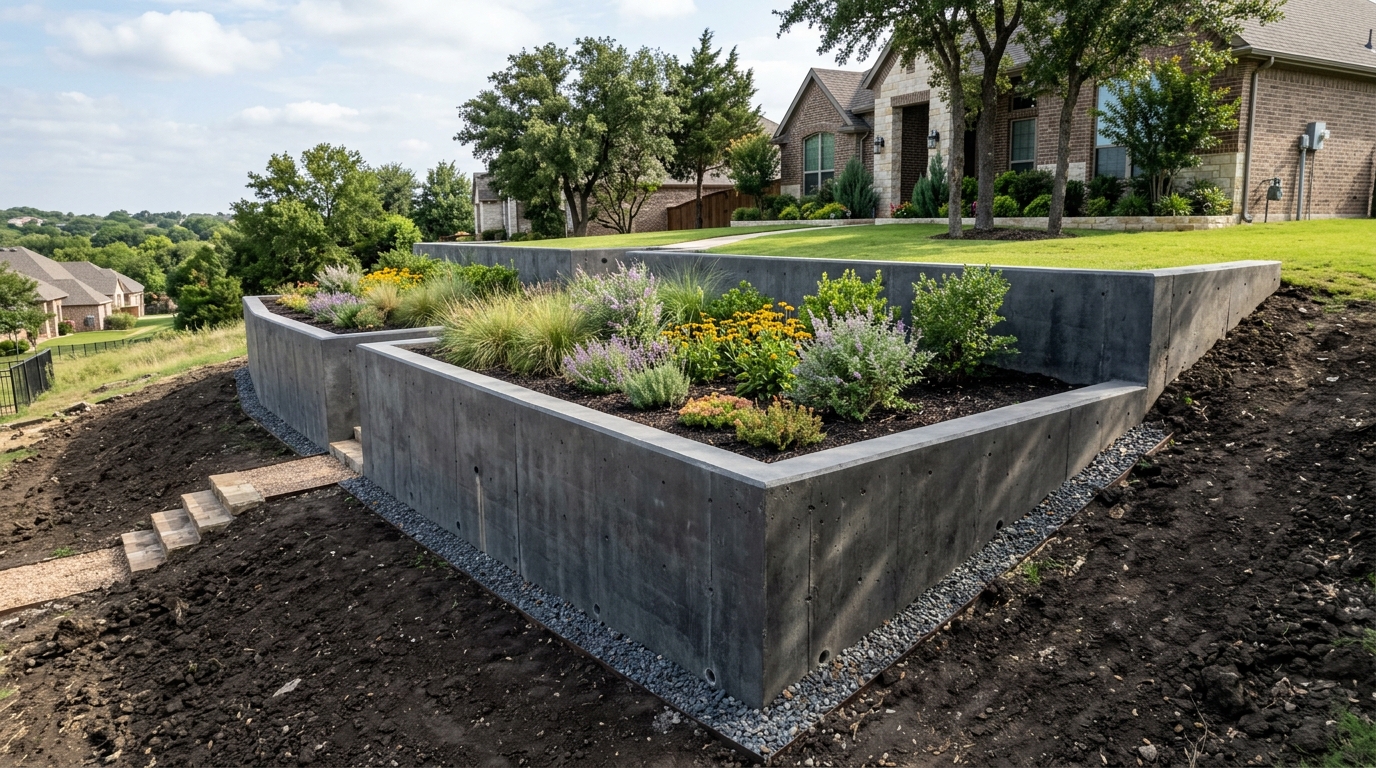
Sloped lots in North Richland Hills create two problems: erosion from the area’s heavy spring rains washing soil down the grade, and the lost usable yard space that a slope creates. The right retaining wall solves both — stopping erosion, creating level usable areas for patios or gardens, and managing drainage in a way that protects the property. The wrong retaining wall, built without proper drainage or structural engineering for NRH’s clay soils, fails — sometimes dramatically — under the hydrostatic pressure that builds behind it after North Texas spring rains.
In this post, we will cover the main retaining wall types available for NRH properties, how each performs on Tarrant County’s expansive clay soils, the drainage design that separates walls that stand from walls that fall, NRH permit requirements for walls over 24 inches, and cost ranges for each type.
Retaining Wall Specialists in North Richland Hills
We design for NRH's clay soils and handle all permit coordination. Call (888) 376-0955 for a free estimate.
Why Drainage Is the Most Critical Design Factor
Before comparing wall types, understand this: the number one cause of retaining wall failure in North Richland Hills is inadequate drainage behind the wall. NRH receives heavy spring rains — sometimes several inches in a single storm event — and that water must have somewhere to go. If it accumulates in the retained soil behind the wall, it creates hydrostatic pressure that increases dramatically with wall height.
A wall without weep holes, drainage pipe, or a gravel drainage layer behind it is holding back water pressure after every rain — in addition to holding back the clay soil’s natural expansion pressure. That combination overwhelms walls that aren’t specifically designed for it.
Every retaining wall we build includes drainage provisions appropriate to the site: perforated pipe at the footing level, a gravel drainage layer behind the wall face, and weep holes at the base of concrete and CMU walls. This isn’t optional; it’s what determines whether the wall stands for decades or fails within a few years.
Retaining Wall Types for NRH Properties
Segmental Retaining Wall Systems (Concrete Block)
Segmental retaining wall systems — products like Allan Block, Versa-Lok, and similar interlocking concrete block — are the most common residential retaining wall solution in NRH. They’re cost-effective, widely available, and can be installed by skilled crews in a variety of heights and curves.
How they work: Segmental blocks are stacked without mortar in a battered (slightly backward-leaning) pattern. The batter, combined with geogrid reinforcement embedded in the soil behind the wall (required for walls over 3 feet), provides the wall’s structural stability.
Best applications: Walls under 4 feet retaining lawn-grade soil loads in residential applications. Decorative garden terracing. Curved walls and complex plan shapes that poured concrete doesn’t accommodate easily.
Limitations on NRH clay: Clay soils exert more lateral pressure than granular soils. For walls over 3 feet on NRH’s clay, geogrid reinforcement extending back into the retained soil is typically required. A segmental wall without geogrid on heavy clay is undersized for the job.
Cost range: $25–$40 per square foot of wall face area, installed.
Free Retaining Wall Assessment in NRH
We'll evaluate your slope, drainage, and soil conditions. Call (888) 376-0955.
Concrete Masonry Unit (CMU) Walls
CMU retaining walls use concrete masonry block (8x8x16-inch hollow block) filled with concrete and reinforced with vertical rebar. They’re stronger than segmental systems and more economical than poured concrete walls for mid-height applications.
How they work: CMU is stacked in courses (mortar-set), with vertical rebar placed in the hollow cores every 16–32 inches, then the cores filled with grout concrete. This creates a reinforced concrete wall within a block formwork.
Best applications: Walls in the 3–6-foot range on clay soils where the extra reinforcement is needed. Commercial applications. Walls where a flat, mortared face is desired.
Cost range: $35–$50 per square foot of wall face area, installed.
Poured Concrete Retaining Walls
Poured concrete walls are the strongest option for tall walls or heavily loaded applications. They require forming (building a wooden or steel mold), placing rebar throughout, and pouring concrete into the form.
Best applications: Walls over 4 feet in height, walls retaining significant soil on expansive clay, walls that will support heavy loads (vehicles, structures), applications where maximum strength-to-thickness ratio matters.
Limitations: More expensive and complex to install than segmental or CMU walls. Require permit review for walls over 24 inches (as do all wall types in NRH).
Cost range: $40–$60+ per square foot of wall face area, installed, depending on wall thickness and height.
NRH Permit Requirements for Retaining Walls
The City of North Richland Hills requires a permit for retaining walls over 24 inches in exposed height. This applies to all wall types — segmental block, CMU, and poured concrete. Walls under 24 inches exposed height generally don’t require a permit for residential applications.
For walls requiring permits, the permit application must include wall design specifications sufficient for the city to verify structural adequacy. We handle all permit coordination for NRH retaining wall projects.
How Clay Soil Affects Retaining Wall Design in NRH
Tarrant County’s Blackland Prairie clay requires specific design considerations:
Higher lateral pressures. Clay soil exerts more lateral pressure than granular soils, particularly when saturated. Wall designs must be calculated for clay’s lateral earth pressure, not the lower values appropriate for sandy soil.
Drainage is mandatory. As discussed above, clay’s water retention and the region’s heavy spring rains make drainage design critical. No retaining wall should be built in NRH without a drainage plan.
Footing depth. Footings must extend below the most active clay layer to find more stable soil, and in some cases, below the frost depth (minimal in NRH but occasionally relevant).
Geogrid for taller segmental walls. Walls over 3 feet on clay soil should include geogrid reinforcement layers embedded in the retained soil, extending back a distance equal to or greater than the wall height.
Cost Summary for NRH Retaining Walls
For a practical example: a 3-foot-tall retaining wall running 20 linear feet (60 square feet of wall face):
- Segmental block: $1,500–$2,400
- CMU: $2,100–$3,000
- Poured concrete: $2,400–$3,600+
All estimates assume proper drainage provisions (perforated pipe, gravel layer) and geogrid where required. Permit fees and site-specific prep costs are additional.
Read more about our retaining wall services for NRH. For the soil context that informs all retaining wall design in Tarrant County, see why NRH clay soil demands reinforced concrete. Use our free cost calculator for a project estimate.
Retaining Walls Built for Tarrant County's Clay Soils
North Richland Hills Concrete Pros designs every wall for NRH's specific drainage and soil conditions. Call (888) 376-0955.
Related: