
Stamped Concrete vs. Pavers: What's Best for NRH Homes?
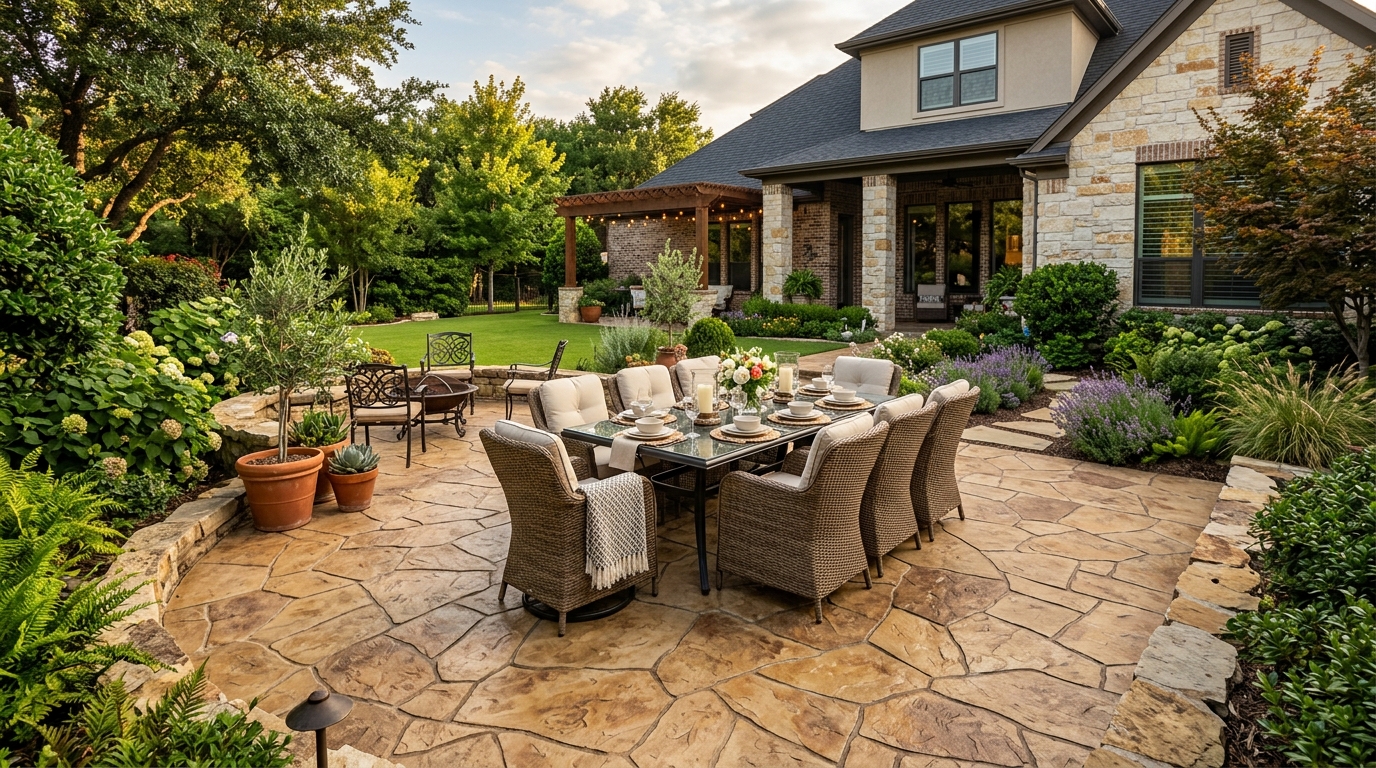
Stamped concrete and pavers are the two premium surface options North Richland Hills homeowners most commonly consider for patios, walkways, and decorative driveways. Both can look excellent and both have legitimate advantages — but the right choice for your NRH property depends significantly on factors specific to this area, particularly Tarrant County’s expansive clay soils and North Texas’s dramatic seasonal conditions.
In this post, we will cover how stamped concrete and pavers compare on upfront cost, long-term maintenance, durability in NRH’s climate, performance on clay soils, and which scenarios favor each option.
Stamped Concrete Specialists in North Richland Hills
We'll help you choose the right surface for your NRH property. Call (888) 376-0955 for a free consultation.
Upfront Cost Comparison
Stamped concrete in North Richland Hills runs $12–$18 per square foot for patios and $14–$20 per square foot for driveways. The cost reflects specialized labor (stamping requires precise timing and skilled technique), color and release agent materials, and the sealer required after curing.
Concrete pavers typically run $15–$25 per square foot installed for standard residential applications, with premium manufactured stone pavers running higher. Natural stone pavers (travertine, bluestone, flagstone) can run $25–$40+ per square foot installed.
On an apples-to-apples basis for a typical 200-square-foot NRH patio, stamped concrete usually costs less than concrete pavers and significantly less than natural stone pavers.
Long-Term Maintenance
Stamped concrete requires:
- Resealing every 2–3 years to maintain color and surface protection — particularly important in NRH’s intense UV environment
- Occasional crack repair if control joints fail to contain movement
- Reapplication of color hardener if severe fading occurs (rare with consistent sealing)
Pavers require:
- Annual or biannual re-sanding of joints to replace sand lost to rain and foot traffic
- Periodic re-leveling of individual pavers that have shifted (common on clay soils as sections move)
- Weed control in joints (polymeric sand helps but doesn’t eliminate weeds long-term)
- Periodic power washing to maintain appearance
On balance, stamped concrete requires less frequent hands-on maintenance (sealing every 2–3 years vs. ongoing joint maintenance), but when stamped concrete does need attention, it typically requires a contractor rather than a DIY fix. Pavers offer the advantage that individual damaged units can be replaced without affecting the rest of the surface.
Free Estimate for Stamped Concrete or Pavers in NRH
North Richland Hills Concrete Pros can help you decide. Call (888) 376-0955.
Performance on NRH’s Clay Soils
This is where the comparison tilts most clearly toward stamped concrete for many NRH applications.
Stamped concrete is a monolithic slab. When NRH’s clay soil shifts seasonally, the entire slab moves together. Control joints direct any cracking to predetermined locations. The slab is reinforced throughout with rebar or mesh to maintain its structural integrity through the movement cycle.
Pavers are individual units set on a compacted base. When clay soil beneath the paver base shifts, individual pavers and sections move independently — some rising, some settling. The result is an uneven surface that develops more pronounced over time, creating trip hazards and drainage problems. On sandy soils (like much of South Texas), pavers can remain level for many years. On NRH’s clay soils, paver leveling is an ongoing maintenance task.
For properties where clay soil movement is pronounced — which includes much of North Richland Hills — stamped concrete’s monolithic nature is a structural advantage over pavers.
Aesthetic Flexibility
Pavers offer genuine material variety — concrete pavers, clay brick, natural travertine, bluestone, and irregular flagstone all look meaningfully different and provide options not replicable in stamped concrete. For homeowners who specifically want the look of natural stone, actual stone pavers deliver something stamped concrete approximates.
Stamped concrete offers a wide range of patterns and color combinations that credibly replicate stone, brick, and wood, but they are imprints in concrete — a skilled observer can distinguish them from natural stone. The range of colors and patterns available in stamped concrete has expanded significantly in recent years, and modern stamping produces very realistic results.
NRH Permit Considerations
For driveways specifically, stamped concrete must meet the same City of NRH specifications as plain concrete — 5-inch minimum thickness, 3,000 psi, #3 rebar on 18-inch centers. Pavers used as driveway surfaces face their own permitting considerations depending on how the driveway approach connects to the public right-of-way.
For patios, neither stamped concrete nor pavers typically require a permit in NRH unless they’re structurally attached to the house. HOA approval may be required for either in communities like Home Town and Thornbridge.
Which Is Better for Your NRH Property?
Choose stamped concrete if:
- You want lower long-term maintenance in a high-movement clay soil environment
- Your primary application is a large patio or driveway
- Budget efficiency matters — stamped concrete generally costs less installed than pavers
- You prefer a seamless surface without joint weeding and re-leveling
Choose pavers if:
- You specifically want natural stone (travertine, flagstone, bluestone)
- The application area is small and the aesthetic is the primary driver
- You want the ability to replace individual units if damage occurs
- The soil movement on your specific lot is minimal (some NRH properties have better-draining soils than others)
Read more about our stamped concrete services or see concrete patio design ideas for NRH homeowners for inspiration on both options.
Not Sure Which Is Right for Your NRH Property?
We'll walk you through both options with honest recommendations for your specific site. Call (888) 376-0955.
Related: