
Why North Richland Hills Clay Soil Demands Reinforced Concrete
Most homeowners in North Richland Hills know their yards are dry and cracked in August and muddy in April — but few understand exactly what that seasonal change means for any concrete on their property. The answer involves one of the most challenging soil types in the country, and it explains why properly installed concrete in NRH looks very different from a slab poured in sandy soil markets.
In this post, we will cover what Blackland Prairie clay is and why it moves so dramatically, how that movement damages concrete driveways, patios, and foundations, what engineering solutions address the problem, and why NRH’s city code requirements exist as a direct response to these soil conditions.
Concrete Built for NRH's Clay Soils
North Richland Hills Concrete Pros designs every pour for Tarrant County's expansive clay — reinforced, drained, and code-compliant.
What Is Blackland Prairie Clay?
The Blackland Prairie is a geological formation that runs roughly 300 miles through central Texas, from the Red River south through the Dallas-Fort Worth metroplex and beyond. Tarrant County — and North Richland Hills specifically — sits squarely on this formation.
Blackland Prairie clay is what geologists call “expansive clay” or “shrink-swell clay.” The mineral composition of these soils — primarily montmorillonite clay minerals — gives them an extraordinary capacity to absorb and release water. When wet, they expand dramatically. When dry, they contract and crack. This is the soil cycle that drives foundation problems, cracked driveways, and heaving patios across the entire DFW area.
Over 50% of the soil in North Texas is expansive clay. For homeowners in NRH, this is simply the reality of where they live — it’s not a problem that goes away, but it is one that can be engineered around.
How Much Does the Soil Actually Move?
The shrink-swell potential of Blackland Prairie clay in Tarrant County can reach 7 inches of vertical movement between the wettest and driest points of the year. That means the ground beneath your driveway may be 7 inches higher in April after heavy spring rains than it is in August during a North Texas drought.
To put that in concrete terms: a 4-inch thick unreinforced slab sitting on soil that moves 3–4 inches will crack. Every time. The only question is how soon and how severely.
The soil also exerts enormous lateral and upward pressure on structures. Expansive clay can generate up to 15,000 pounds per square foot of pressure as it swells — a force that can crack, lift, and tilt concrete structures that aren’t properly reinforced and anchored.
Is Your Driveway or Patio Cracking From Clay Soil?
Call (888) 376-0955 for a free assessment. We'll explain your options — repair or replacement — for NRH's specific soil conditions.
How Clay Soil Damages Concrete in North Richland Hills
Driveways: The most common failure mode is cracking and heaving at the edges of the slab, where clay under the edge expands and pushes upward without the restraint of the interior slab weight above it. Driveway sections that weren’t properly connected with rebar can separate and settle differentially as the clay moves beneath them. The NRH city code requirement for #3 rebar on 18-inch centers exists precisely to tie the slab together so it moves as one unit rather than cracking into separate sections.
Patios: Patio slabs near the house perimeter are at particular risk because the foundation creates a moisture differential — the clay under the house is more consistently damp than the clay under an exposed patio. This moisture gradient causes differential movement that cracks the patio edge. Proper control joints and reinforcement redirect that movement to predictable locations.
Foundations: Home foundations in North Richland Hills are engineered specifically for Blackland clay — the post-tensioned or conventionally reinforced slab-on-grade designs common in NRH are the result of decades of engineering experience with this soil. When moisture imbalance occurs — one side of the foundation dries out while the other remains damp — differential settlement causes the classic cracked drywall, sticking doors, and sloping floors that North Texas homeowners dread. Read our guide on 5 signs your NRH home needs foundation attention.
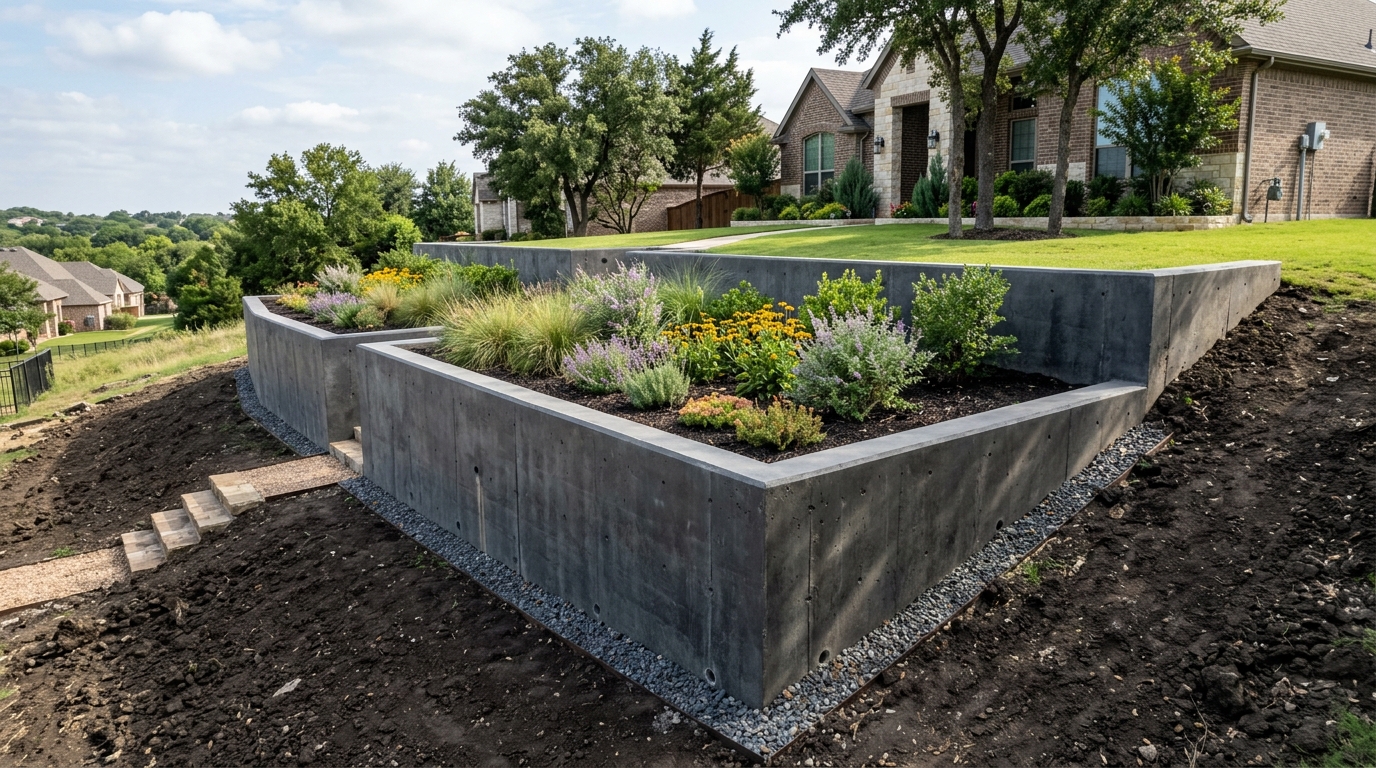
Retaining walls: Walls built to hold back clay soil face significant hydrostatic and lateral expansion pressure during wet periods. A retaining wall without adequate drainage behind it will eventually bow or topple under the pressure of saturated, expanding clay.
What Engineering Solutions Address Expansive Clay
Adequate thickness. The NRH minimum of 5 inches for driveway approaches isn’t arbitrary — thicker concrete has more self-weight to resist upward clay pressure and more structural depth to bridge over voids that form when clay dries and contracts.
Steel reinforcement. Rebar or welded wire mesh ties the slab together, distributing stress across the entire slab rather than allowing individual sections to crack and separate. The NRH-required #3 rebar on 18-inch centers provides this tensile strength in both directions.
Drainage management. Removing water from beneath and around the slab reduces the soil’s moisture swings — the less extreme the wet-dry cycle, the less the clay moves. This includes proper surface slope, sub-base drainage where needed, and keeping water sources (downspouts, irrigation) directed away from the slab perimeter.
Moisture barriers. Under slabs and foundations, moisture barriers slow the rate of water movement from the clay into and out of the concrete system, damping the amplitude of seasonal movement.
Control joints. Tooled or saw-cut joints in the slab surface give the concrete a predetermined cracking location — when the slab must crack (and it will), the crack appears at the joint rather than randomly across the slab face.
Proper base preparation. A well-compacted granular base layer under the slab provides a stable, well-drained platform that reduces the direct contact between the slab and the most reactive clay layers.
Why NRH’s City Code Reflects These Soil Realities
The City of North Richland Hills’ driveway specifications — 5-inch minimum thickness, 3,000 psi compressive strength, #3 rebar on 18-inch centers — weren’t written at random. They represent the city’s engineering judgment about the minimum slab design needed to produce a driveway approach that will survive on Tarrant County’s clay soils for a reasonable service life without becoming a public safety hazard at the curb.
Contractors who install thinner, unreinforced driveways in NRH are cutting corners that the city’s own code prohibits — and they’re producing driveways that will fail in a few years under conditions that properly built slabs would survive for decades. Read our full guide to NRH concrete permits to understand the city’s requirements.
What This Means for Your Concrete Project
If you’re planning a driveway, patio, foundation, or retaining wall in North Richland Hills, the soil conditions should be part of your conversation with any contractor you’re considering. Ask:
- What thickness are you proposing for this slab?
- What reinforcement will you use?
- How are you handling drainage around and beneath the slab?
- Are you familiar with NRH’s specific permit requirements?
A contractor who can’t answer these questions specifically — or who dismisses clay soil concerns — is not the right contractor for NRH conditions.
For specific pricing on what properly built concrete costs in this market, read how much a concrete driveway costs in North Richland Hills. For a broader look at how to evaluate concrete contractors, see our guide on how to choose a concrete contractor in North Richland Hills.
Use our free cost calculator to get a preliminary estimate for your project.
Concrete Engineered for Tarrant County Clay — Free Estimate
North Richland Hills Concrete Pros designs every project for NRH's specific soil conditions. Call (888) 376-0955.
Related: